BPC-157 is the most studied research peptide of the past decade, and one of the most misunderstood. The February 2026 HHS reclassification of BPC-157 from FDA Category 2 back to Category 1 — restoring compounding-pharmacy eligibility with a valid prescription — brought renewed mainstream attention to a peptide that has been quietly dominating orthopedic and regenerative research for years.
One of the most common questions researchers ask about BPC-157 is why it is sold in both oral capsule and injectable vial formats, and whether one is genuinely more effective than the other for laboratory study. The answer is more nuanced than most sources admit. This article walks through what the bioavailability literature actually shows, why BPC-157’s gastric origin changes the usual oral-peptide logic, and how researchers are choosing delivery routes for different research applications in 2026.
What BPC-157 actually is
BPC-157 — short for Body Protection Compound-157 — is a synthetic 15-amino-acid sequence (which is why it is also cataloged in research literature as pentadecapeptide) derived from a protein naturally occurring in human gastric juice. The full sequence, GEPPPGKPADDAGLV, was identified in the 1990s by researchers at the University of Zagreb studying endogenous gastroprotective factors.
Free Tool
Peptide Reconstitution Calculator
Convert vial strength, water volume, and desired dose into precise syringe units. Works for BPC-157, TB-500, GHK-Cu, and all research peptides.
Try the Calculator →That gastric origin is not a marketing detail. It is the single most important fact about how BPC-157 behaves in research models.
Why the “peptides don’t survive oral delivery” rule doesn’t apply the same way
The standard pharmacology claim — that oral peptides are destroyed by gastric acid and digestive enzymes before they can reach systemic circulation — is broadly true for most peptides. That is why GLP-1 agonists, growth hormone secretagogues, and most peptide therapeutics are formulated as injectables or nasal sprays.
BPC-157 is different. The parent protein it derives from is naturally present in gastric juice, meaning the molecule evolved in the presence of gastric acid and digestive enzymes. Published in-vitro stability studies (see the 2023 pharmacokinetic work in Biomolecules) show that BPC-157 maintains substantially higher stability in simulated gastric fluid than unrelated peptide sequences of similar length. This does not mean oral BPC-157 achieves 100% systemic bioavailability — it does not — but the conventional wisdom that oral peptides are pharmacologically inert does not cleanly apply here.
The more accurate framing from the 2026 research literature is that BPC-157 has meaningful — though incomplete — oral bioavailability, with significant local activity in the gastrointestinal mucosa and additional (lower but measurable) systemic absorption.
What the bioavailability data suggests
Research comparing oral and parenteral BPC-157 administration in animal models has consistently shown that:
1. Oral BPC-157 produces measurable systemic effects, including distal tissue repair outcomes in models where the injury site is not in the GI tract. 2. Subcutaneous and intramuscular injection produce higher peak plasma concentrations than oral administration at the same weight-based dose. 3. Local GI effects are more pronounced with oral delivery, which has made capsule formats preferred in research programs investigating gastroprotection, inflammatory bowel model work, and GI-wound models. 4. Half-life is short either way — BPC-157 clears rapidly from circulation, which is one of the reasons dosing frequency matters more than total dose in many research designs.
The practical takeaway: choice of delivery route depends on what the research is investigating, not on a universal “better” answer.
When researchers choose capsules
Oral BPC-157 capsules are typically selected when:
- The research target is gastrointestinal (gastric ulcer models, IBD models, intestinal-wound healing)
- The study protocol requires sustained, lower-peak exposure rather than pulsatile high-peak exposure
- Long-duration studies where handling of injectables becomes logistically difficult
- Comparative bioavailability studies evaluating oral vs. parenteral routes directly
- Pilot studies where lower bioavailability is an acceptable tradeoff for simpler handling
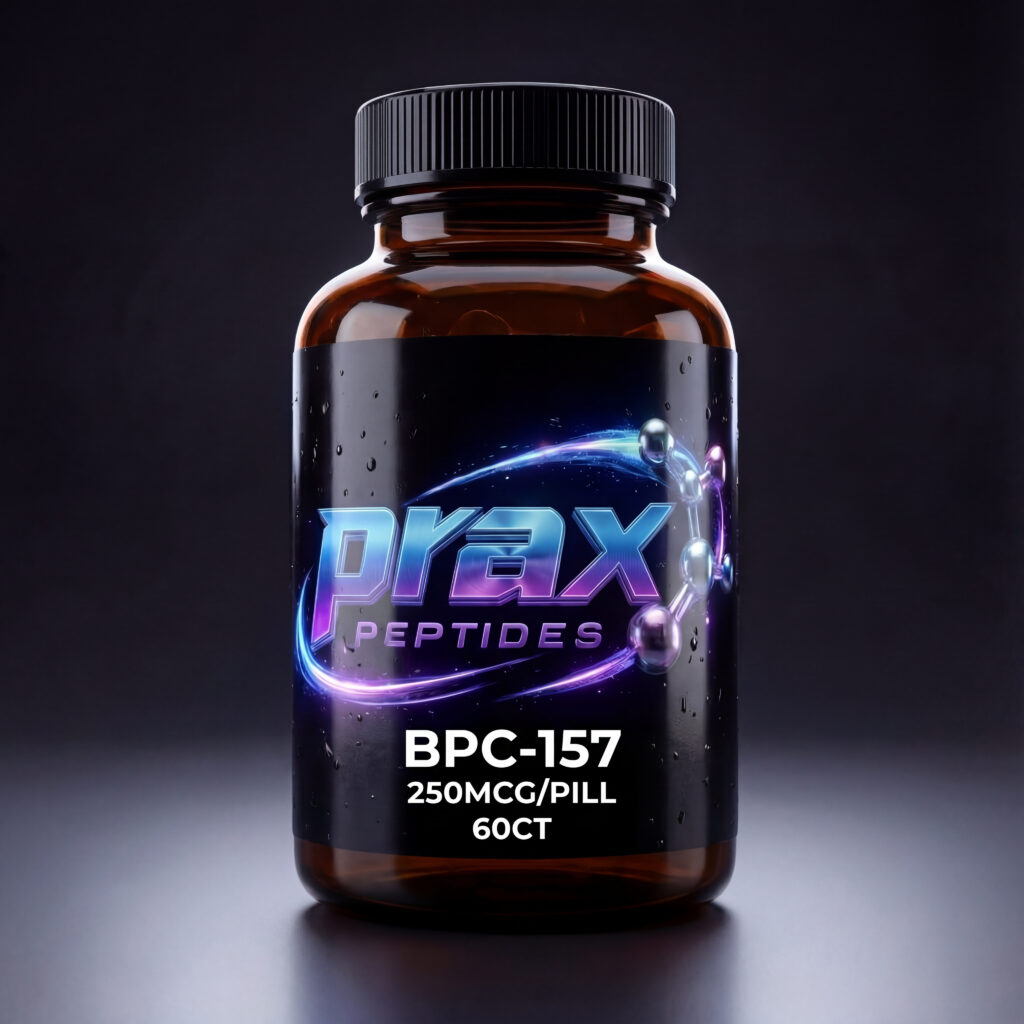
Prax offers BPC-157 in both formats. The BPC-157 250mcg × 60 capsules format is the standard oral presentation. For combined protocols with TB-500, the Wolverine Blend (BPC-157 5mg + TB-500 5mg) is a common multi-peptide research configuration.
When researchers choose injection (vials)
Injectable BPC-157 is typically selected when:
- The research target is musculoskeletal (tendon, ligament, bone, or muscle repair models)
- The study requires high peak plasma concentrations
- Local site-of-injection delivery is the research variable (e.g., tendon-adjacent injection)
- The protocol is adapted from published literature where injectable administration was used
- Dose-response curves across a wide range are being characterized
Prax’s BPC-157 10mg lyophilized vial is the standard injectable research format.
Purity and sourcing — what matters more than format
The capsule-vs-injection question attracts a lot of attention, but it is almost always less important than a question researchers ask too rarely: how do you know the peptide in the vial is actually BPC-157, at the purity the label claims?
In 2026, the benchmarks that matter are:
- ≥99% HPLC purity, verified by a chromatogram available per batch
- Mass spectrometry molecular weight confirmation (BPC-157 theoretical MW: ~1419.5 Da)
- Independent third-party COA rather than in-house manufacturer QC only
- Endotoxin testing (USP <85>) for any peptide intended for cell culture or animal model work
- Transparent batch numbering that ties the COA to the vial in hand
Third-party vendor rating sites like Finnrick and PeptideDeck have begun publishing supplier-level quality comparisons, and the variance across the research peptide industry is wider than most researchers appreciate. Batch-to-batch purity data from unaccredited suppliers has been shown to deviate from labeled purity by as much as 15-20 percentage points.
Frequently asked questions
Is BPC-157 FDA-approved? No. BPC-157 is not FDA-approved as a drug for human use. In February 2026, HHS reclassified BPC-157 from FDA Category 2 back to Category 1, which restored compounding-pharmacy eligibility under a valid physician prescription. Research-grade BPC-157 sold by peptide suppliers is for laboratory research use only.
What is pentadecapeptide? “Pentadecapeptide” is the scientific descriptor referring to any peptide containing 15 amino acids. BPC-157 is the best-known pentadecapeptide in current research, and the two names are often used interchangeably in the literature.
Are oral capsules less effective than injections? Not necessarily. Oral BPC-157 has lower peak plasma concentrations than injectable BPC-157 at equivalent doses, but produces measurable systemic effects and is often preferred for GI-focused research, sustained-exposure studies, and long-duration protocols. The “more effective” answer depends on the research question.
What is the Wolverine Blend? The Wolverine Blend combines BPC-157 combines BPC-157 with TB-500 (thymosin beta-4 fragment) in a single vial. Research programs investigating combined angiogenic and tissue-repair mechanisms frequently use this pairing. Prax’s Wolverine Blend contains 5mg of each peptide per vial.
How should BPC-157 be stored? Lyophilized BPC-157 is stable at refrigerated temperatures for extended periods. Once reconstituted, it should be stored at 2-8°C and used within the timeframe specified on the Certificate of Analysis.
What dosages are available? Prax offers BPC-157 in 10mg lyophilized vials and 250mcg × 60 capsule formats, plus the Wolverine Blend combined with TB-500. Our peptide calculator assists with reconstitution planning for injectable formats.
The bottom line
BPC-157 is the one peptide where the usual “injectable is always better” rule breaks down. Its gastric origin means oral capsules have genuine pharmacological activity, making the format-choice question more about research design than about potency. What matters far more is purity verification, batch-level analytical documentation, and clear research-use sourcing — because in the wake of major vendor shutdowns in Q1 2026, supplier quality variance has grown, not shrunk.
For researchers beginning a BPC-157 program in 2026, the two questions worth answering first are: what am I actually investigating (local GI effects, systemic tissue repair, musculoskeletal models) and can I get a COA on the batch I’m receiving. The capsule-vs-injection answer falls out of the first question; the vendor answer is dictated by the second.
All Prax Peptides products are intended for laboratory research use only. They are not drugs, supplements, or food products, and are not for human or veterinary consumption.