There’s a shift happening in how people approach their health. Not a rejection of medicine — but an expansion of it. Millions of people who’ve spent years cycling through conventional treatments for chronic pain, slow recovery, metabolic dysfunction, and inflammatory conditions are discovering that peptide therapy offers something their previous protocols couldn’t deliver: targeted biological repair without systemic side effects.
This isn’t about replacing your doctor or abandoning evidence-based medicine. It’s about understanding why peptides are filling gaps that traditional pharmaceutical approaches have struggled to close — and why the research community is paying serious attention.
The Limitations of Traditional Medicine for Chronic Conditions
Modern medicine excels at acute care. Broken bones, infections, surgical emergencies, life-threatening illnesses — these are areas where conventional medicine saves lives daily. No one disputes this.
Free Tool
Peptide Reconstitution Calculator
Convert vial strength, water volume, and desired dose into precise syringe units. Works for BPC-157, TB-500, GHK-Cu, and all research peptides.
Try the Calculator →But for chronic conditions — the injuries that won’t fully heal, the inflammation that keeps returning, the metabolic dysfunction that resists lifestyle changes, the gut issues that conventional treatment manages but never resolves — the traditional pharmaceutical model has structural limitations.
The Symptom Management Problem
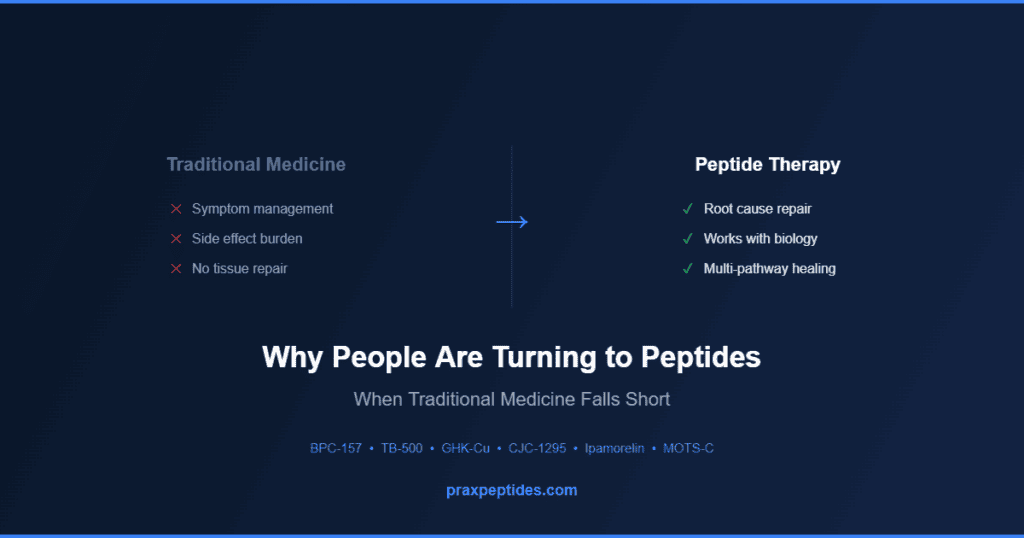
Most conventional medications for chronic conditions are designed to manage symptoms rather than address underlying biological dysfunction. NSAIDs reduce inflammation but don’t repair the damaged tissue causing it. Proton pump inhibitors suppress stomach acid but don’t heal the compromised gut lining. Corticosteroid injections temporarily reduce joint pain but may actually accelerate cartilage degradation over time. Antidepressants modulate neurotransmitter levels but don’t address the neuroinflammation or gut-brain axis dysfunction that may be driving symptoms.
This isn’t a criticism of these medications — they serve important purposes. But for many patients, years of symptom management without resolution creates a frustrating cycle: the underlying condition persists, the medications continue indefinitely, and the body never actually repairs the damage.
The Side Effect Burden
Long-term pharmaceutical use carries cumulative side effects that are well-documented but often underweighted in treatment decisions. Chronic NSAID use damages the gut lining. Long-term corticosteroid use weakens bones and suppresses immune function. Extended antibiotic courses disrupt the microbiome. Statins can cause muscle pain and weakness. Opioids for chronic pain create dependency and worsen pain sensitivity over time.
For patients managing multiple chronic conditions simultaneously — which describes a growing percentage of the adult population — the side effect burden of their medication stack can become a medical problem in itself.
The Recovery Gap
Perhaps the most significant limitation is in tissue repair and recovery. When you tear a tendon, strain a muscle, damage your gut lining, or injure a nerve, conventional medicine offers limited tools to accelerate the actual biological healing process. The standard advice — rest, ice, time, physical therapy — acknowledges that the body heals itself. But it offers little to enhance or accelerate that healing when the body’s natural repair mechanisms are insufficient.
This is precisely the gap that peptide research is addressing.
How Peptides Work Differently
Peptides aren’t drugs in the traditional sense. They’re short chains of amino acids — essentially small proteins — that act as signaling molecules in the body. Many therapeutic peptides are synthetic versions of molecules that already exist naturally in human biology. They work by amplifying or restoring biological processes that the body already uses for repair, immune regulation, and metabolic function.
This is a fundamentally different approach than most pharmaceuticals, which typically block receptors, inhibit enzymes, or override natural processes. Peptides work with the body’s existing systems rather than against them or around them.
BPC-157: The Gut-Healing, Tissue-Repair Peptide
BPC-157 (Body Protection Compound-157) is derived from a protein naturally found in human gastric juice. It’s part of the body’s own gut-protection system. Research has shown it promotes healing across multiple tissue types — tendons, ligaments, muscles, gut lining, blood vessels, and nervous tissue.
Why people are choosing it over traditional approaches:
For tendon injuries, the conventional path is often months of physical therapy, possibly corticosteroid injections (which may weaken the tendon long-term), and if those fail, surgery. BPC-157 research shows accelerated tendon healing, improved collagen organization, and restored biomechanical strength — addressing the actual tissue damage rather than just managing pain.
For gut issues, conventional treatment typically means acid blockers, antibiotics for H. pylori, or immunosuppressants for IBD — all of which manage symptoms while potentially creating new problems. BPC-157’s research demonstrates actual mucosal healing, gut lining restoration, and protection against further damage.
For chronic inflammation, rather than blocking inflammatory pathways entirely (as NSAIDs and corticosteroids do), BPC-157 modulates inflammation while simultaneously promoting repair — addressing both the symptom and the cause.
TB-500: The Tissue Regeneration Peptide
TB-500 (Thymosin Beta-4) is a naturally occurring peptide found in virtually every human cell. It regulates actin — the structural protein that determines how cells move, divide, and organize during repair. It’s also a potent promoter of angiogenesis (new blood vessel formation).
Why people are choosing it over traditional approaches:
For muscle injuries, conventional treatment is essentially time and physical therapy. TB-500 research shows activation of muscle stem cells (satellite cells), enhanced migration of repair cells to injury sites, and promotion of new blood vessel growth that delivers more oxygen and nutrients to damaged tissue.
For cardiovascular concerns, rather than managing risk factors with statins and blood pressure medications indefinitely, TB-500 research demonstrates actual cardiac tissue repair — reduced scarring after cardiac events, improved cardiac cell survival, and promotion of new blood vessel growth in cardiac tissue.
For injuries with poor blood supply (tendons, cartilage, chronic wounds), where healing is slow precisely because these tissues receive limited blood flow, TB-500’s angiogenesis effects directly address the biological bottleneck.
GHK-Cu: The Regenerative Copper Peptide
GHK-Cu is a naturally occurring tripeptide that declines significantly with age. It’s one of the most thoroughly studied peptides in dermatological and wound-healing research.
Why people are choosing it over traditional approaches:
For skin aging, rather than Botox (which paralyzes muscles) or retinoids (which can cause irritation and photosensitivity), GHK-Cu stimulates the body’s own collagen production, promotes skin remodeling, and supports the natural repair processes that slow down with age.
For wound healing, conventional treatment focuses on preventing infection and keeping wounds moist. GHK-Cu research shows accelerated wound closure, improved collagen synthesis, and enhanced tissue remodeling — actually speeding the biological repair process.
CJC-1295 and Ipamorelin: Growth Hormone Optimization
CJC-1295 and Ipamorelin are growth hormone secretagogues — they stimulate the body’s natural production of growth hormone through its existing pulsatile pathway.
Why people are choosing them over traditional approaches:
For age-related decline (increased body fat, decreased muscle mass, poor sleep quality, slow recovery), conventional medicine often says “that’s just aging.” Direct growth hormone replacement carries significant risks and side effects. CJC-1295 and Ipamorelin work by restoring the body’s own GH production patterns rather than overriding them — maintaining the natural pulsatile release while enhancing output.
For body composition, rather than relying solely on caloric restriction (which often causes muscle loss along with fat loss) or stimulant-based fat burners (which carry cardiovascular risks), GH optimization supports fat metabolism and lean mass preservation through the body’s own hormonal pathways.
MOTS-C: The Metabolic Peptide
MOTS-C is a mitochondrial-derived peptide that activates AMPK — often called the body’s metabolic master switch. It improves insulin sensitivity and glucose uptake independent of the insulin signaling pathway.
Why people are choosing it over traditional approaches:
For insulin resistance and prediabetes, the conventional path is typically metformin (which can cause GI side effects) or lifestyle modification alone (which has high failure rates without additional support). MOTS-C research shows improved glucose metabolism through a pathway that complements rather than replaces insulin function — and it mimics some of the metabolic benefits of exercise at the cellular level.
Why Peptides Produce Results That Traditional Approaches Don’t
The pattern across these examples reveals something important about why peptides are gaining traction:
They address root causes, not just symptoms. Rather than blocking pain signals from a damaged tendon, peptides promote actual tendon repair. Rather than suppressing stomach acid to reduce heartburn, they restore gut lining integrity. The goal is resolution, not management.
They work with natural biology, not against it. Because therapeutic peptides are based on molecules that already exist in the human body, they integrate with existing biological systems rather than overriding them. This typically means fewer side effects and better long-term compatibility.
They target multiple repair pathways simultaneously. BPC-157, for example, modulates nitric oxide, upregulates growth factors, reduces inflammation, and promotes blood vessel formation — all at once. This multi-pathway approach mirrors how the body actually heals, rather than isolating a single mechanism.
They support the body’s declining repair capacity. Many peptides (GHK-Cu, MOTS-C, Thymosin Beta-4) naturally decline with age. Restoring their levels doesn’t introduce something foreign — it replenishes something the body used to produce in greater quantities.
Important Caveats
Intellectual honesty requires acknowledging the limitations of the current evidence:
Much of the peptide research is preclinical — animal studies and in vitro work. While results are compelling and biological mechanisms are well-characterized, large-scale human clinical trials are still limited for most therapeutic peptides. The exceptions are BPC-157 and TB-500 (recently restored to Category 1 compounding status) and Thymosin Alpha-1 (approved in 30+ countries).
Peptides are not a replacement for emergency medicine, surgery when needed, or evidence-based treatments for serious conditions like cancer, heart attacks, or acute infections. They’re most relevant for chronic conditions, recovery optimization, and age-related decline — areas where conventional medicine’s tools are more limited.
Quality and sourcing matter enormously. Peptides are amino acid sequences, and their biological activity depends on correct structure and purity. Research-grade peptides from reputable suppliers with third-party testing are fundamentally different from unverified products from unknown sources.
Where to Source Research-Grade Peptides
At Prax Peptides, every product comes with third-party purity testing and transparent certificates of analysis. Our catalog includes BPC-157, TB-500, GHK-Cu, CJC-1295, Ipamorelin, MOTS-C, and a full range of research peptides for serious investigators.
The shift toward peptide research isn’t about rejecting traditional medicine. It’s about recognizing that biological repair — not just symptom suppression — is possible, and that the molecules to support it already exist in human biology. The research is catching up to what the body has known all along.
This article is for informational purposes only and does not constitute medical advice. Consult with a licensed healthcare provider before making any changes to your health protocol.