
Ozempic (semaglutide) has dominated headlines for the past two years. It put GLP-1 receptor agonists on the map, became a cultural phenomenon, and gave millions of people a pharmaceutical option for weight management and metabolic health that actually works.
But the science hasn’t been standing still. Retatrutide — a triple hormone receptor agonist developed by Eli Lilly — is emerging from clinical trials with data that suggests it may be a significant step beyond what Ozempic can do. Not just incrementally better, but mechanistically different in ways that matter for efficacy, metabolic health, and long-term outcomes.
Here’s what the research shows, how the two compounds compare, and why retatrutide is generating so much attention in the peptide and metabolic research communities.
Free Tool
Peptide Reconstitution Calculator
Convert vial strength, water volume, and desired dose into precise syringe units. Works for BPC-157, TB-500, GHK-Cu, and all research peptides.
Try the Calculator →How Ozempic Works: The Single Agonist Approach
Ozempic (semaglutide) is a GLP-1 receptor agonist. It mimics the hormone glucagon-like peptide-1, which is naturally released by the gut after eating. GLP-1 does several things: it stimulates insulin secretion, suppresses glucagon release, slows gastric emptying, and acts on the brain to reduce appetite.
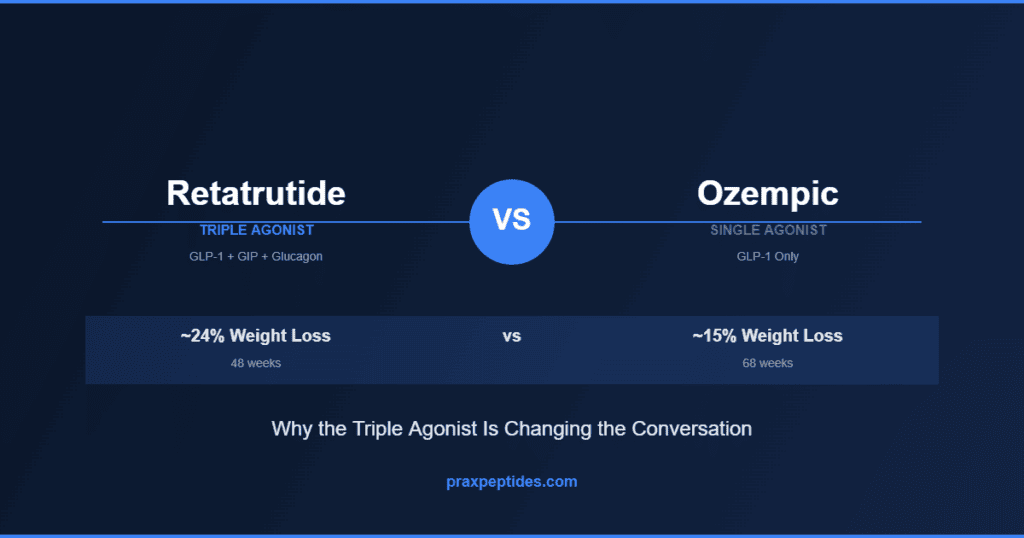
Semaglutide does all of these things effectively. In the STEP clinical trial program, semaglutide at the 2.4mg dose (marketed as Wegovy for weight management) produced average weight loss of approximately 15-17% of body weight over 68 weeks. For a GLP-1 agonist, those are strong numbers.
But semaglutide only activates one receptor — GLP-1. The human metabolic system involves multiple hormonal pathways working together, and targeting just one of them has inherent limitations.
How Retatrutide Works: The Triple Agonist Advantage
Retatrutide is a single molecule that activates three distinct hormone receptors simultaneously: GLP-1 (glucagon-like peptide-1), GIP (glucose-dependent insulinotropic polypeptide), and glucagon receptors.
This triple mechanism isn’t just marketing — each receptor contributes something different to metabolic function.
GLP-1 activation provides the appetite suppression, insulin sensitization, and gastric slowing that made Ozempic effective. Retatrutide includes this entire mechanism.
GIP activation adds a second incretin pathway. GIP enhances insulin secretion through a different signaling cascade than GLP-1, and research suggests it plays a role in fat metabolism and energy expenditure that GLP-1 alone doesn’t fully address. Tirzepatide (Mounjaro/Zepbound), the dual GLP-1/GIP agonist, already demonstrated that adding GIP to GLP-1 produces meaningfully better outcomes than GLP-1 alone.
Glucagon receptor activation is where retatrutide truly differentiates itself. Glucagon — the hormone that raises blood sugar — might seem counterintuitive to include in a metabolic drug. But glucagon does much more than regulate glucose. It directly increases energy expenditure (thermogenesis), promotes lipolysis (fat breakdown), and has significant effects on hepatic fat metabolism. By carefully balancing glucagon activation with GLP-1 and GIP activity, retatrutide stimulates the body to actively burn more energy — not just eat less.
This three-pronged approach means retatrutide addresses energy intake (eating less), energy processing (better insulin and glucose handling), and energy expenditure (burning more) — all at once.
Clinical Trial Results: The Numbers Tell the Story
The Phase 2 clinical trial data for retatrutide, published in the New England Journal of Medicine in 2023, produced results that exceeded expectations across the metabolic research community.
At the highest dose (12mg), participants achieved an average weight loss of approximately 24.2% of body weight over 48 weeks. To put that in perspective, that’s roughly 50% more weight loss than semaglutide achieves — and the trial was only 48 weeks compared to semaglutide’s 68-week STEP trials. The trajectory of the weight loss curves suggested that participants hadn’t yet plateaued at 48 weeks, meaning the ultimate weight loss potential may be even higher.
At the 12mg dose, over 25% of participants lost more than 30% of their body weight. These are numbers that were previously only achievable through bariatric surgery.
But weight loss alone isn’t the full picture. The metabolic improvements were equally striking.
Beyond Weight Loss: Metabolic Health Advantages
Liver Fat Reduction
One of the most significant findings from the retatrutide trials was its effect on liver fat. Non-alcoholic fatty liver disease (NAFLD) and its more severe form, NASH, affect an estimated 25-30% of adults globally and are closely linked to metabolic syndrome, type 2 diabetes, and cardiovascular disease.
In the retatrutide Phase 2 trial, participants showed dramatic reductions in liver fat — with many achieving complete normalization of hepatic fat content. This effect is likely driven significantly by the glucagon receptor component, since glucagon plays a direct role in hepatic lipid metabolism. Semaglutide has shown some liver fat reduction, but the magnitude of retatrutide’s effect appears substantially greater.
Insulin Sensitivity
Both semaglutide and retatrutide improve insulin sensitivity, but they do so through partially different mechanisms. Semaglutide improves insulin sensitivity primarily through weight loss and direct GLP-1-mediated effects on pancreatic beta cells. Retatrutide adds GIP-mediated insulin effects and glucagon-mediated improvements in hepatic glucose metabolism, providing multiple parallel pathways to better glycemic control.
Cardiovascular Markers
While long-term cardiovascular outcome data for retatrutide is still being generated (the Phase 3 program is ongoing), the metabolic improvements observed — dramatic weight loss, liver fat reduction, improved lipid profiles, and enhanced insulin sensitivity — are all strongly associated with reduced cardiovascular risk. Semaglutide has already demonstrated cardiovascular benefits in the SELECT trial; retatrutide’s more comprehensive metabolic effects suggest at least comparable, and potentially superior, cardiovascular protection.
Side Effect Profile Comparison
Both compounds share the GLP-1-related side effects that are common across this drug class: nausea, vomiting, diarrhea, and constipation. These are typically most pronounced during dose escalation and often diminish over time.
The key question with retatrutide is whether the additional GIP and glucagon receptor activity introduces new safety concerns. Based on Phase 2 data, the overall tolerability profile was broadly similar to other incretin-based therapies. The glucagon component raised theoretical concerns about blood sugar elevation, but in practice, the GLP-1 and GIP components appear to counterbalance this effectively — participants actually showed improved glycemic control, not worsened.
Semaglutide’s side effect profile is well-characterized after years of clinical use, which gives it an advantage in terms of real-world safety data. Retatrutide’s long-term safety profile is still being established through ongoing Phase 3 trials.
One area where retatrutide may have an advantage: muscle preservation. Early data and the mechanistic rationale (glucagon-mediated energy expenditure means more calories burned rather than just fewer consumed) suggest that retatrutide may preserve lean muscle mass better than GLP-1-only approaches during weight loss. This is a critical concern with all weight loss therapies — losing muscle along with fat undermines long-term metabolic health and functional capacity.
Cost and Accessibility
Ozempic and Wegovy (both semaglutide products from Novo Nordisk) carry list prices of approximately $900-1,300 per month without insurance. Supply constraints have been a persistent issue, with shortages affecting availability for both diabetes patients and weight management patients.
Retatrutide pricing hasn’t been finalized since it’s still in Phase 3 trials, but several factors suggest it may offer better value. As an Eli Lilly product, it enters a competitive market where Lilly has already demonstrated willingness to price aggressively (Zepbound launched at a lower price point than Wegovy). The superior efficacy data — achieving greater results potentially in shorter timeframes — means the cost-per-outcome may be significantly more favorable. If patients reach their goals faster or maintain results more effectively, the total treatment cost decreases.
For the compounding pharmacy market, the peptide research community is closely watching retatrutide’s regulatory pathway. The compound’s triple-agonist structure makes it more complex to compound than simpler GLP-1 analogs, but research-grade peptide suppliers are already preparing for demand.
At Prax Peptides, we stay at the forefront of emerging peptide research. While retatrutide is currently only available through clinical trials, we carry a comprehensive selection of research peptides in related metabolic pathways, including CJC-1295 and Ipamorelin for growth hormone optimization, MOTS-C for mitochondrial and metabolic research, and BPC-157 for tissue repair and gut health research.
What This Means for the Future of Metabolic Medicine
The progression from single agonist (semaglutide) to dual agonist (tirzepatide) to triple agonist (retatrutide) represents a clear trajectory in metabolic medicine: more comprehensive hormonal modulation produces better outcomes. Each additional receptor target doesn’t just add — it multiplies effectiveness by addressing different aspects of metabolic dysfunction simultaneously.
Retatrutide isn’t just a better version of Ozempic. It’s a fundamentally more complete approach to metabolic health — one that addresses not just appetite, but energy expenditure, liver health, insulin sensitivity, and body composition through three coordinated mechanisms.
The Phase 3 trial program (currently underway) will provide the definitive data on long-term efficacy, safety, and real-world outcomes. But based on what the science has shown so far, the triple agonist approach represents a meaningful advance over what single-agonist GLP-1 drugs can achieve alone.
This article is for informational purposes only and does not constitute medical advice. Consult with a licensed healthcare provider regarding any medication or treatment decisions.