

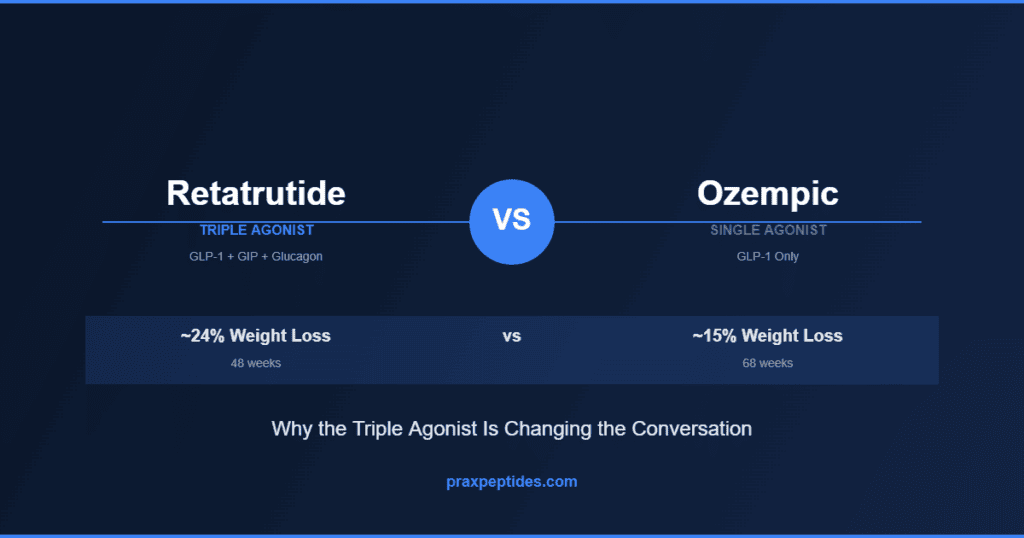

The GLP-1 receptor agonist class has evolved rapidly over the past decade, from single-receptor GLP-1 analogs to dual and now triple receptor agonists. For researchers and clinicians tracking this space, understanding the mechanistic and clinical differences between semaglutide, tirzepatide, and retatrutide is increasingly important. This guide provides a direct comparison across the key parameters.
Receptor Target Comparison
The fundamental differentiator across these three agents is which receptors they engage and with what potency.
| Agent | GLP-1R | GIPR | GCGR | Generation |
|---|---|---|---|---|
| Semaglutide | ✓ (primary) | — | — | 1st gen |
| Tirzepatide | ✓ | ✓ (primary) | — | 2nd gen (dual) |
| Retatrutide | ✓ | ✓ | ✓ | 3rd gen (triple) |
Mechanism of Action: What Each Receptor Does
GLP-1 Receptor (GLP-1R)
The GLP-1 receptor mediates glucose-dependent insulin secretion, glucagon suppression, gastric emptying delay, and appetite reduction via hypothalamic signaling. It is the core mechanism shared by all three agents. GLP-1R agonism also has cardioprotective effects demonstrated in CVOT trials (LEADER, SUSTAIN-6, SELECT).
Free Tool
Peptide Reconstitution Calculator
Convert vial strength, water volume, and desired dose into precise syringe units. Works for BPC-157, TB-500, GHK-Cu, and all research peptides.
Try the Calculator →GIP Receptor (GIPR)
GIP (glucose-dependent insulinotropic polypeptide) was historically considered a less useful target because GIP receptor agonism alone does not reduce body weight. However, combined GIP/GLP-1 agonism appears to have synergistic or additive effects on weight loss — a paradox still being researched. GIPR agonism may also act on adipose tissue to enhance lipid metabolism and reduce inflammation.
Glucagon Receptor (GCGR)
Glucagon receptor agonism raises concern at first glance because glucagon increases blood glucose. However, in the context of combined GLP-1/GIP/glucagon agonism, the glucagon component appears to increase energy expenditure, promote lipolysis, and reduce hepatic fat without net adverse glycemic effect — largely because the GLP-1R component compensates. This is what makes triple agonism potentially superior for weight loss and NAFLD versus dual agonism alone.
Clinical Trial Weight Loss Data
| Agent | Trial | Duration | Mean Weight Loss | Highest Dose |
|---|---|---|---|---|
| Semaglutide 2.4mg | STEP 1 | 68 weeks | ~14.9% | 2.4 mg/week SQ |
| Tirzepatide 15mg | SURMOUNT-1 | 72 weeks | ~20.9% | 15 mg/week SQ |
| Retatrutide 12mg | Phase 2 (NCT04881760) | 48 weeks | ~24.2% | 12 mg/week SQ |
These figures represent mean weight loss from baseline in participants with obesity (BMI ≥30 or ≥27 with comorbidities) without type 2 diabetes. Retatrutide’s 48-week data showed continued weight loss trajectory that had not plateaued, suggesting the 72-week number could be higher. Phase 3 data (TRIUMPH program) is ongoing.
Half-Life and Dosing Frequency
All three agents are designed for once-weekly subcutaneous administration, though their structural mechanisms for achieving extended half-life differ. Semaglutide uses albumin binding via an 18-carbon fatty diacid chain, giving it the longest half-life of approximately 7 days. Tirzepatide uses a modified fatty acid chain with a PEG linker, with a half-life of approximately 5 days. Retatrutide employs a C20 fatty diacid chain similar in design to semaglutide, with a half-life of approximately 6 days.
Side Effect Profiles
All three agents share a broadly similar GI side effect profile dominated by nausea, vomiting, diarrhea, and constipation, particularly during dose escalation. These are class effects driven primarily by GLP-1R agonism slowing gastric motility. Retatrutide’s glucagon component may theoretically contribute to additional effects, though Phase 2 data did not reveal meaningfully different tolerability versus tirzepatide at equivalent doses.
Research Applications
For researchers studying metabolic disease, obesity, NAFLD, or the incretin system, the choice between these agents depends on the specific research question. Semaglutide provides the deepest evidence base for cardiovascular outcomes. Tirzepatide is the most characterized dual agonist with completed Phase 3 data. Retatrutide is the leading edge of triple agonism research and is particularly relevant for studies focused on energy expenditure mechanisms and hepatic steatosis.
Prax Peptides offers independently tested research-grade semaglutide, tirzepatide, and retatrutide for preclinical research applications, each with ≥99% purity verified by third-party HPLC and mass spectrometry.
Summary
The progression from semaglutide to tirzepatide to retatrutide represents a deliberate escalation in receptor engagement complexity, each generation achieving meaningfully greater weight loss outcomes in clinical trials. Retatrutide’s triple agonism mechanism represents the current frontier of GLP-1 class development, with Phase 3 data expected to further characterize its long-term efficacy and safety profile.
⚠️ Research Use Only: All compounds referenced on this site are intended strictly for laboratory research purposes. They are not approved for human use or consumption by the FDA or any regulatory authority. This content is for informational purposes only and does not constitute medical advice.