' . $js . ''; }, 999);
Prax Peptides — Where Science Meets Precision.

Skin Healing Peptides vs. Tretinoin vs. Accutane: A Research-Based Comparison of Mechanisms, Efficacy, and Safety

skin-healing-peptides-vs-retinoids-featured — research peptide from Prax Peptides

Disclaimer: This article is intended for educational and research purposes only. The compounds discussed below are sold strictly as research chemicals and are not intended for human consumption. Nothing in this article constitutes medical advice. Consult a licensed healthcare professional before making any decisions about skin treatments.

The landscape of skin repair and regeneration research has expanded dramatically over the past decade. While retinoids like tretinoin and isotretinoin (Accutane) have long dominated dermatological research, a growing body of preclinical and early clinical evidence points to bioactive peptides as a fundamentally different approach to skin healing — one that works with the body’s own repair mechanisms rather than forcing cellular turnover through chemical signaling.

This article examines three categories of compounds side by side: traditional retinoids (tretinoin and isotretinoin), the gastric pentadecapeptide BPC-157, and thymosin beta-4 (TB-500). We’ll compare their mechanisms of action, what the published research actually shows, their safety profiles, and where each compound fits in the broader picture of dermatological science.

Free Tool

Peptide Reconstitution Calculator

Convert vial strength, water volume, and reference dose into precise syringe units. Works for BPC-157, TB-500, GHK-Cu, and all research peptides.

Try the Calculator →

Understanding the Skin’s Repair Machinery

Before comparing compounds, it helps to understand what skin healing actually requires at the cellular level. When skin is damaged — whether by UV radiation, chemical burns, surgical incisions, or chronic inflammation — the body initiates a four-phase repair cascade: hemostasis (blood clotting), inflammation (immune response), proliferation (new tissue formation), and remodeling (scar maturation and collagen reorganization).

Each phase involves different cell types, signaling molecules, and growth factors. The key players include fibroblasts (which produce collagen and extracellular matrix), keratinocytes (which form the skin barrier), endothelial cells (which build new blood vessels), and various immune cells that manage inflammation. A compound’s value in skin healing depends on which of these phases and cell types it influences — and whether it accelerates healing without disrupting the delicate balance between them.

Retinoids: Tretinoin and Isotretinoin (Accutane)

Chemical Profile and Mechanism

Tretinoin (all-trans retinoic acid) and isotretinoin (13-cis retinoic acid) are both first-generation retinoids — derivatives of vitamin A. Despite their chemical similarity, they operate through markedly different pathways.

Tretinoin is applied topically and works directly on the skin surface. It binds to retinoic acid receptors (RARs) in keratinocytes and fibroblasts, activating genes involved in cell differentiation and proliferation. The practical effect is accelerated cell turnover: old, damaged skin cells are pushed to the surface and shed more rapidly, while new cells form underneath. Over time, this process increases epidermal thickness, stimulates collagen synthesis in the dermis, and improves the organization of the skin’s extracellular matrix. Research has demonstrated tretinoin’s ability to reduce fine lines, improve skin texture, and reverse some photodamage markers.

Isotretinoin (Accutane) is taken orally and works systemically. Its primary mechanism is the dramatic reduction of sebaceous gland size and activity — shrinking oil-producing glands by up to 90%. This makes it extraordinarily effective against severe nodular acne, with research indicating clearance rates approaching 85% after a single 4-to-5-month course. However, its systemic nature means it affects every tissue in the body that has retinoid receptors, which explains its extensive side effect profile.

Research Evidence for Skin Healing

Tretinoin has decades of clinical evidence supporting its role in photoaging reversal. Multiple randomized controlled trials have demonstrated statistically significant improvements in fine wrinkles, mottled hyperpigmentation, and skin roughness with daily topical application over 6 to 12 months. Its collagen-stimulating properties are well-documented: tretinoin increases type I and type III procollagen synthesis in photodamaged skin, partially restoring the dermal collagen network that breaks down with chronic UV exposure.

However, tretinoin’s approach to “healing” is fundamentally a forced-turnover model. It doesn’t accelerate the body’s natural wound repair process — it chemically signals cells to divide faster. This distinction matters because the mechanism comes with inherent limitations: an initial worsening period (the “retinoid purge” lasting 4 to 8 weeks), ongoing irritation, dryness, and photosensitivity, and the inability to be used on actively wounded or compromised skin.

Isotretinoin’s skin effects are even more aggressive. While profoundly effective for severe acne, the compound’s systemic mechanism produces widespread reported adverse events in literature including severe dryness of the lips (cheilitis), skin fragility (xeroderma), dry eyes, increased sun sensitivity, and — more seriously — teratogenicity (birth defects requiring mandatory pregnancy prevention programs), associations with mood changes and depression in some patients, and emerging research linking it to potential long-term sexual reported adverse events in literature.

Limitations as Healing Agents

The core limitation of retinoids in the context of skin healing is that they are fundamentally remodeling agents, not repair agents. They excel at restructuring existing skin — improving texture, reducing hyperpigmentation, stimulating collagen in intact dermis — but they actually impair wound healing when applied to damaged skin. Tretinoin is contraindicated on open wounds, sunburned skin, and eczematous skin precisely because its forced-turnover mechanism disrupts the delicate inflammatory and proliferative phases of natural wound repair.

This creates a significant gap: for patients dealing with actual tissue damage — surgical scars, burns, chronic wounds, or inflammatory skin conditions — retinoids are either contraindicated or offer indirect benefit at best. This is where peptide-based approaches present a fundamentally different proposition.

BPC-157: The Body Protection Compound

Chemical Profile and Mechanism

BPC-157 (Body Protection Compound-157) is a synthetic pentadecapeptide — a chain of 15 amino acids — derived from a protective protein found in human gastric juice. Its sequence (Gly-Glu-Pro-Pro-Pro-Gly-Lys-Pro-Ala-Asp-Asp-Ala-Gly-Leu-Val) was isolated and stabilized for research purposes. Unlike retinoids, which force cellular behavior through receptor binding, BPC-157 appears to work by modulating the body’s existing repair pathways — essentially amplifying signals that are already part of the natural healing cascade.

Research published in the Journal of Physiology-Paris and indexed on PubMed has identified several key mechanisms through which BPC-157 influences skin repair:

Angiogenesis promotion: BPC-157 significantly upregulates vascular endothelial growth factor (VEGF) expression in wounded tissues. New blood vessel formation is critical during the proliferative phase of wound healing because it delivers oxygen and nutrients to the repair site. Studies using chick embryo chorioallantoic membrane (CAM) assays demonstrated that BPC-157 promotes the formation of new blood vessels in a dose-dependent manner.

ERK1/2 pathway modulation: Research published in Drug Design, Development and Therapy showed that BPC-157 regulates the phosphorylation of extracellular signal-regulated kinases 1 and 2 (ERK1/2), which are central molecules in cell growth, migration, and new blood vessel formation. This is significant because ERK signaling is one of the master switches controlling whether damaged tissue enters a productive repair cycle or stalls in chronic inflammation.

Collagen deposition: Multiple animal studies have documented significantly higher collagen content in BPC-157-treated wounds compared to controls. Research demonstrated increased collagen organization in granulation tissue and accelerated reepithelialization — the process by which new skin cells migrate across a wound to close it.

Anti-inflammatory action: BPC-157 modulates the inflammatory phase of healing without suppressing it entirely, which is a crucial distinction. Complete suppression of inflammation (as with corticosteroids) impairs healing, while excessive inflammation leads to scarring. BPC-157 appears to shift the balance toward productive, resolution-phase inflammation.

Research Evidence for Skin Healing

The preclinical evidence for BPC-157 in skin repair is substantial and growing. A study published in Drug Design, Development and Therapy examined BPC-157’s effects on alkali-burn wounds in vivo and found that it enhanced wound healing by promoting proliferation, migration, and angiogenesis. The treated wounds showed better granulation tissue formation, faster reepithelialization, improved dermal remodeling, and higher collagen deposition compared to untreated controls.

A comprehensive review published in Current Pharmaceutical Design cataloged BPC-157’s effects across multiple wound types and models, noting consistent acceleration of healing in skin incisions, burns (including alkali and thermal), and diabetic wound models — the latter being particularly significant since diabetic wounds are notoriously resistant to healing due to impaired vascular function.

Chinese researchers have also explored BPC-157 as a component of advanced medical dressings for scar repair. Their work showed that BPC-157-infused dressings created an effective protective layer on wound surfaces while increasing skin cuticle water content — suggesting benefits for both the repair process and the quality of the resulting tissue.

A 2025 pilot study administering intravenous BPC-157 infusions up to 20 mg in healthy adults found the treatment was well tolerated, with no adverse events or clinically meaningful changes in vital signs or laboratory biomarkers — an important early safety signal for human use, though larger trials are needed.

TB-500 (Thymosin Beta-4): The Migration Peptide

Chemical Profile and Mechanism

TB-500 is a synthetic peptide that replicates the active region (amino acids 17–23) of thymosin beta-4, a naturally occurring 43-amino-acid protein produced in nearly every nucleated cell in the human body. Thymosin beta-4 is one of the most abundant intracellular peptides, and its primary intracellular function is sequestering G-actin monomers — the building blocks of the cellular skeleton. This actin-regulating role is directly relevant to wound healing because cell migration (the movement of keratinocytes, fibroblasts, and endothelial cells to a wound site) depends on dynamic actin reorganization.

The mechanisms through which TB-500 promotes skin healing are distinct from both retinoids and BPC-157:

Cell migration acceleration: TB-500’s primary contribution is dramatically increasing the rate at which repair cells move to damaged tissue. By modulating actin polymerization, it allows keratinocytes and endothelial cells to migrate faster and more directionally toward wound sites. This is arguably the most critical bottleneck in wound healing — getting repair cells to the right place at the right time.

Stem cell mobilization: Research has demonstrated that thymosin beta-4 promotes the mobilization and differentiation of stem and progenitor cells, potentially increasing the body’s pool of repair-capable cells beyond what is normally available.

Anti-inflammatory and anti-apoptotic effects: TB-500 reduces inflammatory signaling while simultaneously preventing premature cell death (apoptosis) in the wound environment. This dual action keeps more repair cells alive and functional while preventing the chronic inflammation that leads to poor healing outcomes and excessive scarring.

Angiogenesis: Like BPC-157, TB-500 promotes new blood vessel formation, ensuring adequate blood supply to healing tissues. However, the two peptides appear to achieve this through different signaling pathways, which raises interesting questions about potential synergistic effects when used in combination for research purposes.

Research Evidence for Skin Healing

The dermal healing evidence for TB-500 spans both animal models and human clinical trials — placing it further along the translational research pipeline than many peptides.

A landmark study published in the Annals of the New York Academy of Sciences demonstrated that thymosin beta-4 accelerated dermal healing of full-thickness punch wounds across multiple animal models, including normal rats and mice, steroid-treated rats (which have impaired healing), diabetic mice (another impaired healing model), and aged mice. The consistency across these diverse models is notable because it suggests the mechanism is robust enough to work even when other repair pathways are compromised.

Perhaps most significantly, two Phase 2 clinical trials examined thymosin beta-4 in human patients with chronic stasis ulcers and pressure ulcers. The results showed acceleration of healing by nearly a month in patients who responded — a clinically meaningful improvement for wounds that often resist treatment for months or years.

An important nuance emerged from metabolic research: the wound-healing activity previously attributed to TB-500 may partially be due to its metabolite Ac-LKKTE rather than the parent compound itself. Published in the Journal of Chromatography B, this finding doesn’t diminish the therapeutic potential but refines our understanding of the active molecular species involved.

Head-to-Head: Mechanisms Compared

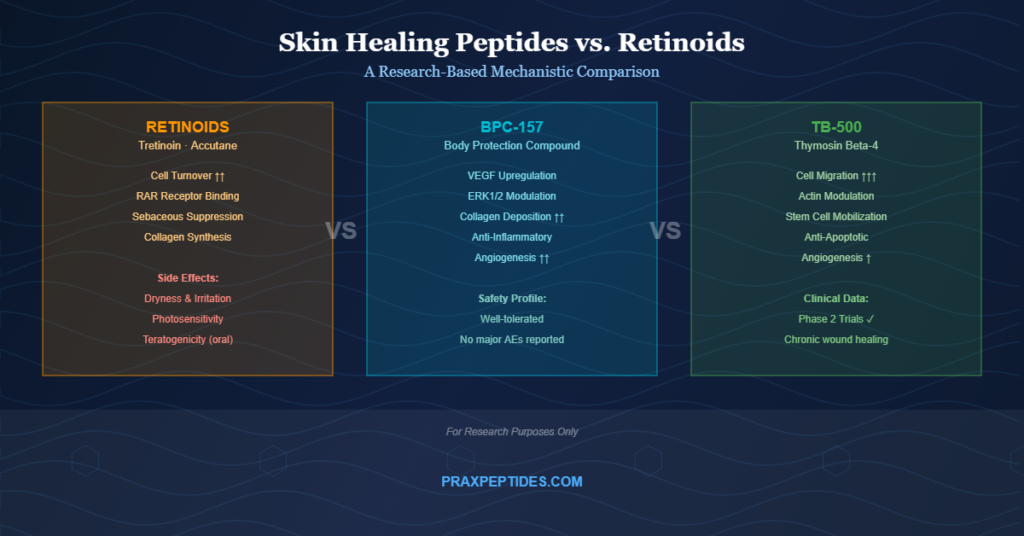
When you line up these compounds by mechanism, the fundamental philosophical differences become clear:

Tretinoin operates through a forced-turnover model. It binds retinoid receptors and chemically instructs cells to divide faster, shed faster, and produce more collagen. It’s effective for remodeling intact skin but cannot be used on damaged tissue and causes significant irritation as a baseline effect. Think of it as a renovation contractor — excellent at upgrading existing structures, but not the right call for emergency repairs.

Isotretinoin (Accutane) is a systemic sledgehammer. It shrinks sebaceous glands body-wide, fundamentally altering skin biology for months after discontinuation. Extraordinarily effective for severe acne, but its non-selective systemic action produces widespread reported adverse events in literature that make it unsuitable as a general skin-healing agent.

BPC-157 works as a repair signal amplifier. Rather than forcing cells to behave differently, it upregulates the growth factors and signaling pathways that are already part of the natural healing cascade — VEGF for blood vessel formation, ERK1/2 for cell proliferation, and collagen deposition pathways for structural repair. It’s the equivalent of turning up the volume on a signal the body is already sending.

TB-500 is a cellular logistics coordinator. Its primary contribution is getting repair cells to the wound site faster through actin modulation and stem cell mobilization, while simultaneously protecting those cells from inflammation and premature death. If BPC-157 amplifies the repair signal, TB-500 ensures the repair crews actually arrive.

Safety Profiles: A Critical Comparison

Safety is where the differences between these compound categories become most stark.

Tretinoin is generally well-tolerated but causes predictable reported adverse events in literature: erythema (redness), peeling, dryness, and photosensitivity. These effects are essentially built into the mechanism — you cannot force accelerated cell turnover without some irritation. Most users adapt over 4 to 8 weeks, but some never tolerate it well. Tretinoin is pregnancy category X (contraindicated).

Isotretinoin carries a substantially heavier side effect burden. Universal effects include severe dryness of lips and skin, while more concerning associations include mood changes, depression, elevated liver enzymes, altered lipid profiles, musculoskeletal pain, and — most critically — severe teratogenicity requiring enrollment in mandatory risk-management programs (iPLEDGE in the United States). Emerging research has also raised questions about potential long-term effects on sexual function and hormonal balance that persist after discontinuation.

BPC-157 has shown a remarkably clean safety profile in the research available to date. The 2025 pilot study with IV administration up to 20 mg in healthy adults reported no adverse events. Animal studies across hundreds of published papers have consistently reported minimal toxicity even at high doses. However, it must be emphasized that human clinical data remains limited, and BPC-157 has not received FDA approval for any indication.

TB-500 has demonstrated good tolerability in both animal studies and the Phase 2 clinical trials for chronic wounds. The naturally occurring parent molecule (thymosin beta-4) is present in virtually every cell in the body, which provides a theoretical basis for its favorable safety profile — the body already produces and processes this molecule as part of normal physiology.

The Synergy Question: BPC-157 and TB-500 Together

One of the most active areas of current research involves the potential synergistic effects of combining BPC-157 and TB-500 in wound healing models. The theoretical basis is compelling: BPC-157 amplifies growth factor signaling and collagen deposition while TB-500 accelerates cell migration and protects repair cells from inflammatory damage. These are complementary, non-overlapping mechanisms — BPC-157 makes the wound environment more conducive to healing while TB-500 ensures the healing cells get there faster and survive longer.

While peer-reviewed combination studies are still limited, the distinct mechanistic profiles suggest that the two peptides could theoretically address different bottlenecks in the healing process simultaneously, potentially producing outcomes greater than either compound alone. This remains an active and promising area of investigation for researchers studying wound repair.

Where the Research Stands: Honest Assessment

It would be intellectually dishonest to present these compounds without acknowledging the significant differences in their evidence bases.

Tretinoin has the strongest clinical evidence of any compound discussed here. Decades of randomized controlled trials, meta-analyses, and real-world clinical data support its efficacy for photoaging, acne, and skin texture improvement. It is FDA-approved and widely prescribed.

Isotretinoin similarly has robust clinical evidence for severe acne, backed by decades of use and extensive pharmacovigilance data. Its FDA approval came in 1982, and its efficacy is not in question — only whether its side effect profile is acceptable for a given patient.

BPC-157 has substantial preclinical evidence (hundreds of published studies) and early-phase human data, but lacks the large-scale randomized controlled trials that would be required for regulatory approval. The preclinical data is consistently positive across diverse wound models and research groups, which lends credibility, but the translational gap between animal models and human clinical outcomes remains a legitimate caveat.

TB-500 is the furthest along the peptide translational pipeline, with two completed Phase 2 clinical trials in chronic wounds showing meaningful clinical improvement. The human data, while still limited in scale, provides stronger translational evidence than most peptides in this category.

Implications for Future Research

The compounds discussed in this article represent fundamentally different philosophies of skin intervention. Retinoids work by overriding normal cellular behavior — forcing faster turnover, suppressing oil production, chemically instructing cells to produce more collagen. Peptides like BPC-157 and TB-500 appear to work by supporting and amplifying the body’s existing repair infrastructure — upregulating growth factors, accelerating cell migration, improving blood supply to damaged tissue.

Neither approach is inherently superior. For chronic photoaging and acne, retinoids have proven, documented efficacy with well-understood risk profiles. For actual tissue repair — wounds, burns, surgical recovery, and conditions where the skin’s healing capacity is compromised — peptide-based approaches offer a mechanistically distinct pathway that addresses the specific bottlenecks in wound repair.

The most exciting frontier may not be choosing between these categories but understanding how they might complement each other across different phases of skin health. Retinoids for long-term structural maintenance, peptides for acute repair and recovery — these are not competing approaches so much as different tools for different problems.

For researchers interested in exploring these compounds, Prax Peptides offers research-grade BPC-157 (10mg) and TB-500 (10mg), both independently tested for purity and identity. All compounds are sold strictly for research purposes.

References and Further Reading:

  • Seiwerth S, et al. “Stable Gastric Pentadecapeptide BPC 157 and Wound Healing.” Current Pharmaceutical Design, 2021. PMC8275860
  • Chang CH, et al. “Body protective compound-157 enhances alkali-burn wound healing in vivo.” Drug Design, Development and Therapy, 2015. PMC4425239
  • Malinda KM, et al. “Thymosin beta4 accelerates wound healing.” Journal of Investigative Dermatology, 1999. PMID: 10469335
  • Philp D, et al. “The regenerative peptide thymosin β4 accelerates the rate of dermal healing in preclinical animal models and in patients.” Annals of the New York Academy of Sciences, 2012. PMID: 23050815
  • Pickart L, et al. “GHK Peptide as a Natural Modulator of Multiple Cellular Pathways in Skin Regeneration.” BioMed Research International, 2015. PMC4508379
  • Mukherjee S, et al. “Retinoids in the treatment of skin aging.” Clinical Interventions in Aging, 2006.

Explore our full range of research-grade peptides with third-party purity verification at praxpeptides.com/shop.

All compounds discussed in this article are intended strictly for in-vitro research and laboratory use only. They are not intended for human consumption, veterinary use, or any clinical application. Researchers are responsible for ensuring compliance with all applicable regulations in their jurisdiction.

Featured Research Peptides

Lab-tested. 99%+ purity. 30-day quality guarantee.

Scroll to Top