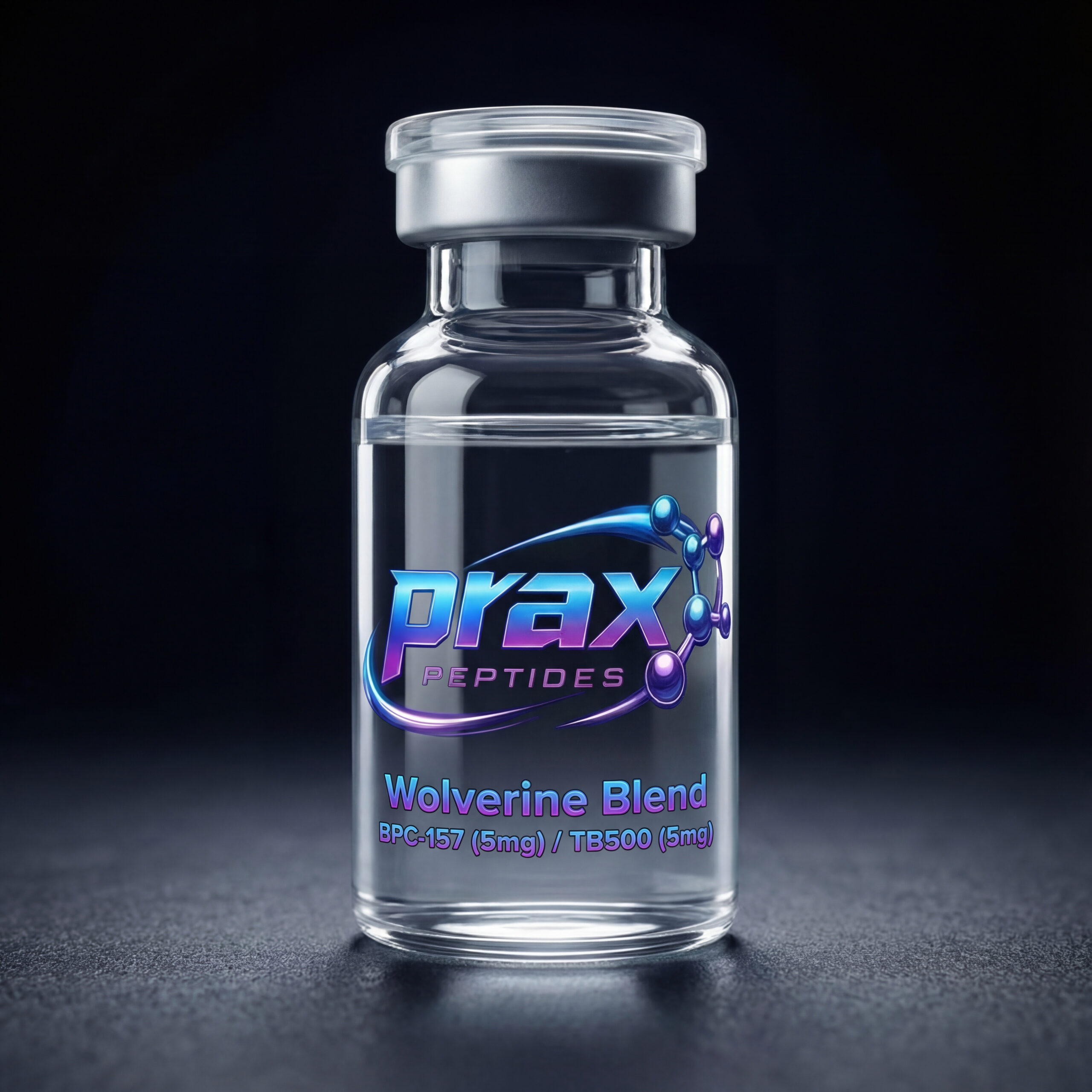
What is Wolverine Blend – BPC-157 (5 mg) / TB-500 (5 mg)?
Wolverine Blend is a research-grade peptide combination that unites two well-known compounds—BPC-157 and TB-500 (Thymosin β4 Fragment) for advanced tissue regeneration and angiogenesis studies.
This formulation is designed exclusively for laboratory research, providing scientists with a dual-peptide model to examine cell migration, vascular growth, and soft-tissue recovery mechanisms.
-
BPC-157 (Body Protection Compound-157) – a synthetic pentadecapeptide derived from a gastric protective protein, studied for its potential in tissue protection, angiogenic signaling, and anti-inflammatory activity.
-
TB-500 (Thymosin β4 Fragment 17-23) – a short amino acid sequence researched for its ability to support cellular migration, actin reorganization, and wound-healing models.
When combined, these peptides serve as a synergistic system for exploring repair biology, vascular remodeling, and cellular communication in pre-clinical and in-vitro environments.
For laboratory research use only. Not for human consumption.
Structure of Chemicals – Prax Peptides
Chemical Structure of Wolverine Blend – BPC-157 (5 mg) / TB-500 (5 mg)
BPC-157
Sequence: Gly-Glu-Pro-Pro-Pro-Gly-Lys-Pro-Ala-Asp-Asp-Ala-Gly-Leu-Val
Molecular Weight: ~1,419.56 g/mol
Thymosin β4 Fragment (17-23)
Sequence: Leu-Lys-Lys-Thr-Glu-Thr-Gln
Molecular Weight: ~846.97 g/mol
The Wolverine Blend is supplied as a single lyophilized powder, combining both peptides at ≥98.5 % HPLC purity for precise, reproducible research outcomes.
This blend allows investigators to evaluate growth-factor modulation, cellular repair kinetics, and multi-pathway recovery processes under controlled conditions.
Medical – Prax Peptides
What Are the Effects of Wolverine Blend – BPC-157 (5 mg) / TB-500 (5 mg)?
Tissue Repair & Regeneration Research
In experimental models, BPC-157 has demonstrated roles in fibroblast activation, growth-factor receptor expression, and angiogenic signaling through VEGF and NO pathways.
The Thymosin β4 fragment contributes by promoting cell migration, actin-filament organization, and wound-site cell movement.
Together, the two peptides are studied for their complementary effects on cellular environment optimization and vascular repair in soft-tissue models.
Anti-Inflammatory and Protective Pathways
Research shows that BPC-157 may modulate inflammatory cytokine cascades and support vascular and neural tissue stability under oxidative or mechanical stress.
The TB-500 fragment is investigated for matrix stabilization, extracellular remodeling, and vascular regeneration processes in tissue-healing research.
Experimental Applications
Common areas of study include:
-
Tendon and ligament regeneration models
-
Skeletal muscle recovery
-
Microvascular injury repair
-
Neurovascular and endothelial regeneration pathways
All findings to date are based on in-vitro and animal research; no human clinical data exist for this specific blend.
Disclaimer
All Prax Peptides compounds are intended for laboratory research use only.
They are not approved for human or veterinary use, therapeutic treatment, or dietary supplementation.
Handle only in controlled laboratory settings by qualified personnel.
Purity and identity are verified; no therapeutic claims are made or implied.
Reviews
There are no reviews yet.