Important: All compounds discussed in this article, including Ipamorelin and CJC-1295 No DAC, are intended for laboratory research use only. They are not intended for human consumption, and nothing in this article should be interpreted as medical advice or a recommendation for personal use.
Ipamorelin and CJC-1295 No DAC: Why Researchers Are Studying This Growth Hormone Secretagogue Blend
Among the most widely studied peptide combinations in growth hormone research, the Ipamorelin / CJC-1295 No DAC blend has emerged as a leading area of interest. This combination pairs two distinct growth hormone releasing peptides (GHRPs) that work through complementary mechanisms — and the research suggests the combination may be more effective than either peptide alone.
This article breaks down what the science says about each compound individually, why researchers combine them, and what the preclinical and early clinical data indicate about potential applications — particularly in the context of myogenic signalling, metabolic regulation, and recovery.
Free Tool
Peptide Reconstitution Calculator
Convert vial strength, water volume, and reference dose into precise syringe units. Works for BPC-157, TB-500, GHK-Cu, and all research peptides.
Try the Calculator →What Is Ipamorelin?
Ipamorelin is a synthetic pentapeptide — a chain of five amino acids — that acts as a selective growth hormone secretagogue. It stimulates the pituitary gland to release growth hormone (GH) by mimicking the action of ghrelin, the body’s natural hunger and GH-releasing hormone.
What makes Ipamorelin particularly interesting to researchers is its selectivity. Unlike older growth hormone secretagogues such as GHRP-6 and GHRP-2, Ipamorelin stimulates GH release without significantly increasing cortisol, prolactin, or aldosterone levels. This selectivity is a major advantage in research settings because it allows scientists to study growth hormone effects in relative isolation from other hormonal variables.
Key Research Findings on Ipamorelin
Preclinical studies have demonstrated that Ipamorelin produces a dose-dependent increase in plasma growth hormone levels. In animal models, it has shown the ability to increase bone mineral density, support lean body mass, and promote recovery from injury — all consistent with elevated GH activity.
Ipamorelin’s GH release pattern also mimics the body’s natural pulsatile secretion more closely than continuous GH administration, which researchers believe may produce more physiologically relevant effects.
What Is CJC-1295 No DAC?
CJC-1295 No DAC (also called Modified GRF 1-29 or Mod GRF) is a synthetic analog of growth hormone releasing hormone (GHRH). While Ipamorelin works at the ghrelin receptor, CJC-1295 No DAC works at the GHRH receptor — a completely different signaling pathway that also stimulates the pituitary to release growth hormone.
The “No DAC” designation is important. The original CJC-1295 included a Drug Affinity Complex (DAC) that extended its half-life to several days. The No DAC version has a shorter half-life of approximately 30 minutes, which produces a more natural, pulse-like GH release pattern. For research purposes, this shorter-acting version is generally preferred because it more closely mimics endogenous GHRH signaling.
Key Research Findings on CJC-1295 No DAC
Studies have shown that CJC-1295 No DAC increases GH and IGF-1 (insulin-like growth factor 1) levels in research subjects. It amplifies the natural GH pulse rather than creating a constant, elevated baseline — a distinction that researchers believe is important for minimizing reported adverse events in literature while maximizing the physiological benefits of GH elevation.
Why Combine Them? The Synergy Effect
The rationale for combining Ipamorelin and CJC-1295 No DAC is rooted in basic receptor pharmacology. These two peptides stimulate growth hormone release through two entirely different receptor pathways:
Ipamorelin activates the ghrelin receptor (GHS-R1a) on the pituitary → triggers GH release
CJC-1295 No DAC activates the GHRH receptor on the pituitary → amplifies and sustains the GH pulse
When administered together, research indicates that the resulting GH release is significantly greater than either peptide alone. This is not simply additive — the combination appears to produce a synergistic effect where the total GH output exceeds the sum of each individual contribution.
This dual-pathway approach is why the Ipamorelin / CJC-1295 No DAC blend has become one of the most popular peptide combinations in growth hormone research.
Hypothetical Myogenic Signalling Benefits in Research
Growth hormone’s role in muscle development and metabolic regulation is well-established in the scientific literature. The Ipamorelin / CJC-1295 No DAC combination is being studied specifically for its potential to influence these pathways. Here’s what the research suggests:
1. Increased Growth Hormone Pulsatility
The combination produces robust, pulsatile GH release that closely mirrors the natural secretion pattern seen during deep sleep and intense exercise. This pulsatile pattern is associated in research with greater anabolic signaling compared to sustained GH elevation — meaning the body may respond more effectively to pulse-released GH than to a constant supply.
2. Elevated IGF-1 Levels
Growth hormone stimulates the liver to produce IGF-1, which is a primary mediator of GH’s anabolic effects on muscle tissue. Preclinical research shows that the Ipamorelin / CJC-1295 combination reliably increases circulating IGF-1 levels. IGF-1 promotes protein synthesis, supports satellite cell activation in muscle tissue, and plays a role in muscle repair after damage.
3. Enhanced Protein Synthesis
Through the GH → IGF-1 axis, this peptide combination may support increased rates of muscle protein synthesis — the fundamental process by which muscles grow and repair. Animal studies have demonstrated increased lean mass accretion in subjects receiving GH secretagogue treatment versus controls.
4. Reduced Muscle Wasting
Research into GH secretagogues has shown potential for combating muscle wasting conditions, including age-related sarcopenia and disuse atrophy. The ability of Ipamorelin and CJC-1295 to stimulate endogenous GH production — rather than introducing exogenous GH — may offer a more physiologically compatible approach to addressing muscle loss.
5. Improved Recovery
GH plays a well-documented role in tissue repair and recovery. Elevated GH and IGF-1 levels are associated with faster recovery from exercise-induced muscle damage in preclinical models. This recovery angle is of particular interest when considering this blend alongside other recovery-focused research peptides like BPC-157 and TB-500.
6. Metabolic Regulation Effects
Beyond myogenic signalling specifically, GH has well-documented effects on metabolic regulation — promoting lean mass while simultaneously supporting fat metabolism. The lipolytic (fat-burning) effects of GH are mediated partly through direct action on adipocytes and partly through IGF-1. Research into Tesamorelin, another GHRH analog, has demonstrated significant reductions in visceral adipose tissue, suggesting the broader GH secretagogue class has meaningful metabolic regulation applications.
Research Dosing and the Peptide Calculator
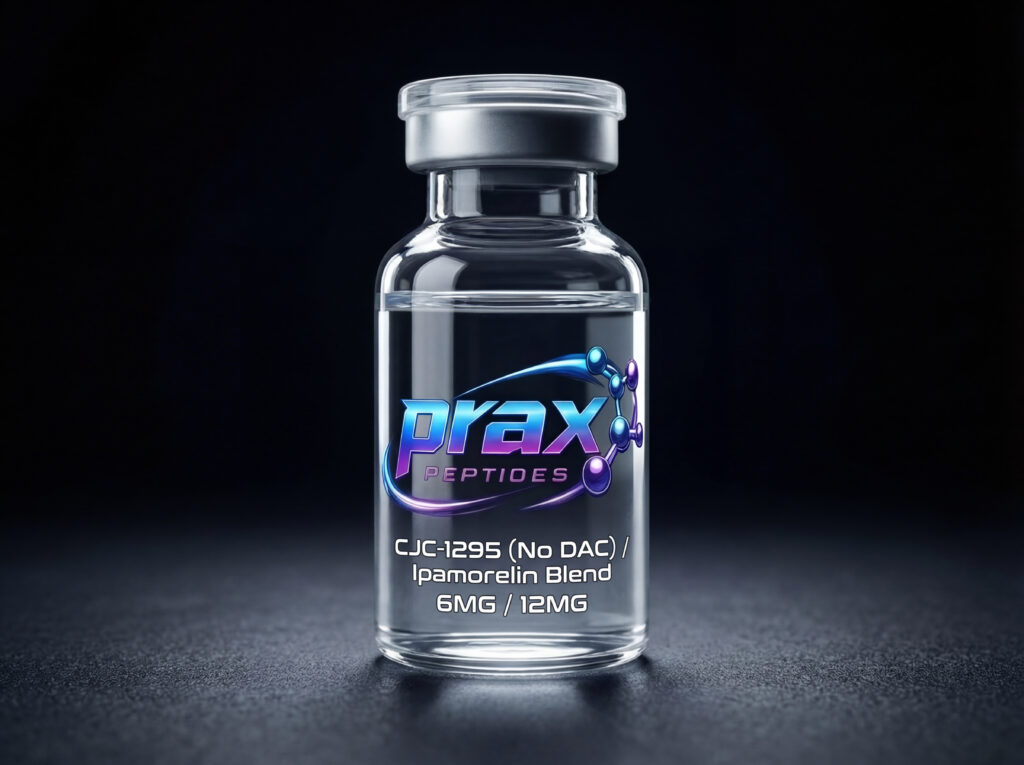
Proper reconstitution and dosing calculations are critical for accurate research results. Because this blend contains two peptides at different concentrations (CJC-1295 No DAC at 6mg and Ipamorelin at 12mg for a total of 18mg per vial), calculating precise research doses requires attention to the math.
Prax Peptides provides a free Peptide Reconstitution Calculator that takes the guesswork out of this process. Simply input your vial strength, bacteriostatic water volume, and desired dose — the calculator handles the conversion to precise syringe units. This tool works for the Ipamorelin / CJC-1295 blend and all other research peptides.
For reconstitution, researchers typically use bacteriostatic water (BAC water) to maintain peptide stability over multiple uses.
Complementary Research Compounds
Many research protocols explore the Ipamorelin / CJC-1295 blend as part of a broader compound stack. Some commonly studied combinations include:
Ipamorelin / CJC-1295 + BPC-157: BPC-157 is studied for tissue repair and gut healing. Combined with the GH-releasing effects of the Ipamorelin/CJC blend, researchers explore whether the combination supports faster recovery and more comprehensive tissue repair.
Ipamorelin / CJC-1295 + MOTS-c: MOTS-c targets metabolic regulation and exercise mimetics. Pairing metabolic optimization with GH elevation is a research angle aimed at understanding metabolic regulation changes more completely.
Ipamorelin / CJC-1295 + Wolverine Blend: The Wolverine Blend (BPC-157/TB-500) addresses tissue repair from multiple angles. Adding GH secretagogue activity to this recovery stack is being investigated for accelerated healing protocols.
Ipamorelin / CJC-1295 + NAD+: NAD+ supports cellular energy production and mitochondrial function. The combination of enhanced cellular energy (NAD+) with increased growth signaling (GH/IGF-1) represents a research approach to age-related decline in both energy and tissue maintenance.
Potential reported adverse events in literature and Considerations
While Ipamorelin and CJC-1295 No DAC are generally considered well-tolerated in research settings compared to other GH secretagogues, potential considerations include:
Water retention: GH elevation can cause temporary water retention, which is typically dose-dependent and reversible.
Numbness or tingling: Some research reports note transient paresthesia (tingling in extremities), consistent with GH-mediated effects.
Increased hunger: While Ipamorelin is more selective than GHRP-6, some ghrelin receptor activation may still influence appetite signaling.
Injection site reactions: As with any injectable research compound, localized redness or irritation at the injection site may occur.
Long-term safety data: Comprehensive long-term safety studies in humans are limited. Researchers should consider this gap when designing extended protocols.
Cancer considerations: As with any compound that elevates GH and IGF-1 levels, there is a theoretical concern about promoting growth in existing malignant cells. This remains an active area of investigation.
Why Purity Matters
Growth hormone secretagogue research requires high-purity compounds to produce reliable, reproducible results. Impurities in peptide preparations can introduce confounding variables, affect binding affinity, and compromise data integrity.
The Ipamorelin / CJC-1295 No DAC blend from Prax Peptides is manufactured under strict quality controls with 99%+ purity verification, full certificate of analysis documentation, and independent third-party testing. Every batch is verified before shipping to ensure researchers receive compounds they can trust.
The Bottom Line
The Ipamorelin / CJC-1295 No DAC combination represents one of the most well-studied and promising approaches to growth hormone secretagogue research. By targeting two distinct receptor pathways simultaneously, this blend produces synergistic GH release that supports investigation into muscle development, metabolic regulation, recovery, and age-related hormonal decline.
For researchers looking to explore this combination, Prax Peptides offers the Ipamorelin / CJC-1295 No DAC blend with full purity documentation and fast shipping. Use our Peptide Reconstitution Calculator to dial in precise research doses, and browse our complete research peptide catalog for complementary compounds.
Disclaimer: This article is intended for educational and informational purposes only. Ipamorelin, CJC-1295 No DAC, and all compounds mentioned are sold strictly for laboratory research purposes. They are not intended for human consumption. Nothing in this article constitutes medical advice. Always consult qualified healthcare professionals for medical decisions.
All compounds discussed in this article are intended strictly for in-vitro research and laboratory use only. They are not intended for human consumption, veterinary use, or any clinical application. Researchers are responsible for ensuring compliance with all applicable regulations in their jurisdiction.