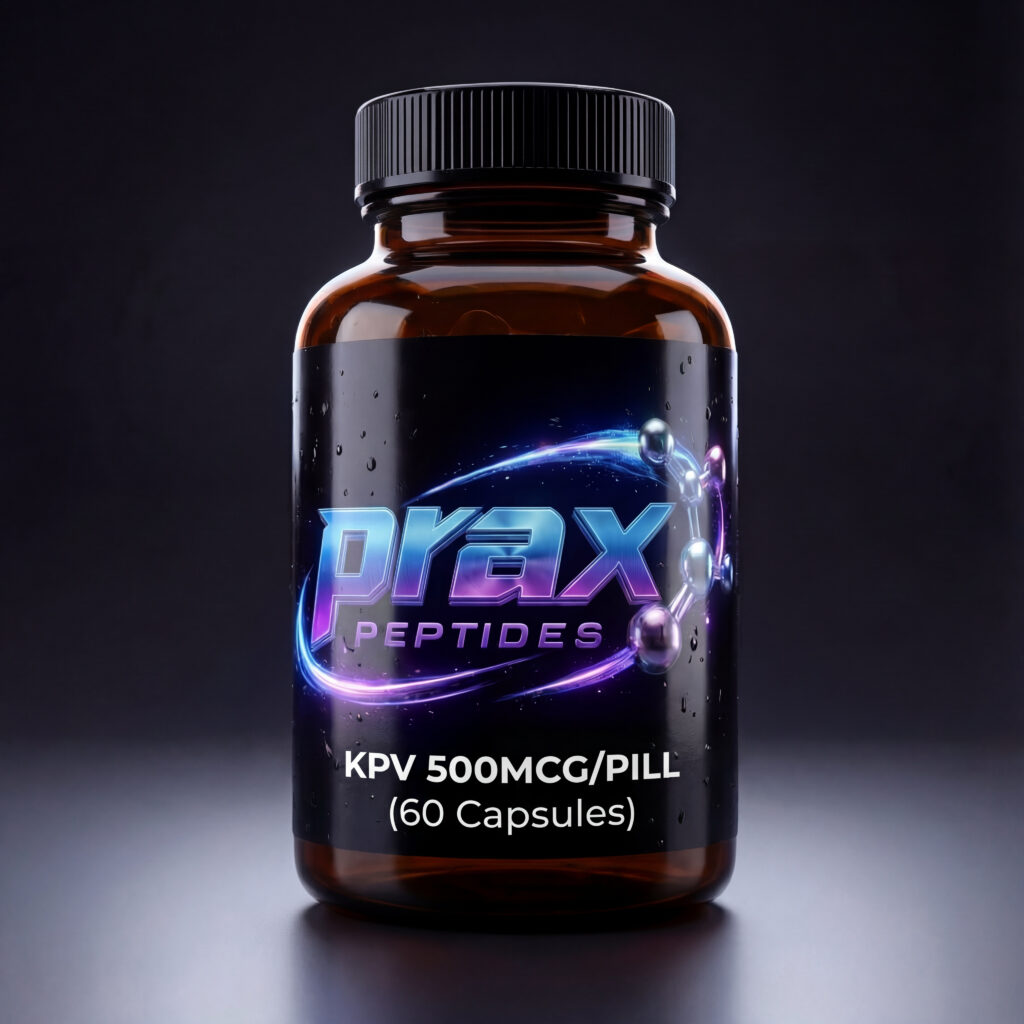
Let me tell you something most people miss about peptide research. The molecules that end up mattering the most are almost never the ones with the loudest marketing. They’re the quiet ones. The ones a handful of researchers keep coming back to, year after year, because the data keeps pointing somewhere interesting.
KPV is one of those molecules.
If you’ve spent any time in peptide research circles in the last two years, you’ve probably seen the name pop up. A tripeptide. Three amino acids — Lysine, Proline, Valine. That’s it. No exotic modifications. No patented delivery system. Just a short, stable fragment derived from the C-terminal end of alpha-MSH, the same parent molecule the melanocortin family comes from.
Free Tool
Peptide Reconstitution Calculator
Convert vial strength, water volume, and desired dose into precise syringe units. Works for BPC-157, TB-500, GHK-Cu, and all research peptides.
Try the Calculator →And yet, the research community keeps circling back to it. Here’s why.
What KPV Actually Is
KPV (Lys-Pro-Val) is a tripeptide fragment of α-melanocyte-stimulating hormone (α-MSH). α-MSH is a well-studied peptide with a long history in inflammation and pigmentation research. But the full α-MSH molecule is complicated. It hits multiple receptors. It has off-target effects. It’s hard to work with.
Researchers noticed something interesting decades ago: you could strip α-MSH down to just its last three amino acids — KPV — and the anti-inflammatory signaling still worked. Without most of the complications of the parent molecule.
That’s the entire pitch in one sentence. KPV is what happens when you take the useful part of α-MSH and throw away the rest.
Three amino acids. Stable. Cheap to make. Well-characterized in the literature. And — allegedly — active on some of the most studied inflammatory pathways in biology.
What The Research Literature Actually Says
Here’s where I have to be careful, and I want you to pay attention to this because it matters. Everything below is from published research literature. None of it is medical advice. None of it describes approved human uses. KPV is a research chemical. Full stop.
With that said, here’s what has shown up in the published literature over the last two decades:
- **Anti-inflammatory signaling in cell and animal models.** This is the most consistently reported finding. KPV has been studied in models of inflammatory bowel disease, colitis, and various skin inflammation models. Published work from groups studying gut epithelial cells has reported reductions in NF-κB signaling and pro-inflammatory cytokine output in treated cells.
- **Oral bioavailability and gut targeting.** One of the unusual things about KPV — and the reason researchers keep coming back to it — is that it appears to survive oral administration better than most peptides, and the gut itself is one of its most-studied targets. Published work has explored nanoparticle and hydrogel delivery specifically for colonic research.
- **Skin research models.** Because α-MSH has a long history in skin biology, KPV has been studied in dermal inflammation models. Topical formulations have shown up in the literature as a research tool.
I want to underline once more: this is published research literature, not clinical guidance. The peer-reviewed work is in cell culture, animal models, and early exploratory human research. Nothing on this page is a claim about what KPV does in a human body in a real-world setting.
Why This Tripeptide Is On So Many Research Radars Right Now
Ask yourself this. With thousands of peptides out there, why does KPV specifically keep showing up in preprints and in research-community conversations in 2026?
Three reasons, and they stack.
First, it’s stable. Most peptides are floppy, fragile molecules that fall apart in minutes once they hit physiological conditions. A three-amino-acid sequence with proline in the middle is unusually resistant to proteolysis. That stability is a huge deal when you’re trying to design a reproducible experiment.
Second, it’s cheap. A tripeptide is about as simple as a peptide can get. Solid-phase synthesis of KPV is routine. That means labs around the world can run experiments with it without a million-dollar budget — and that’s exactly the kind of molecule that ends up accumulating a big public literature.
Third, it fits the moment. Inflammation is having a decade. Gut biology is having a decade. The overlap between those two fields — where KPV sits — is one of the hottest corners of biomedical research right now. Any research tool that plugs into that conversation is going to get attention.
What The Chatter Is (And How To Think About It)
Now, here’s the part where I want to level with you. If you hang around peptide research forums, you’ll see claims about KPV that go well beyond the published literature. Recovery. Skin quality. Autoimmune this and autoimmune that. I’m not going to repeat any of it here, because most of it is anecdotal, it’s not what the peer-reviewed work actually says, and this is a research-use site.
What I will say is this: the published literature is the only real signal. Anecdotes are not data. If you’re trying to figure out whether a molecule is worth your attention as a researcher, the question is not “what are people saying on forums.” The question is “what does the methodologically-clean work say, and where are the gaps.”
For KPV, the clean work says: interesting anti-inflammatory signaling in models, oral stability is unusually good for a peptide, more human data would help. That’s the honest summary.
How Researchers Work With KPV In The Lab
For research use only, a few practical points that come up in the literature:
- **Form.** KPV is commonly available as a lyophilized powder for reconstitution and, in some research contexts, as an oral capsule form intended for in vivo animal research protocols.
- **Stability.** Lyophilized peptide stored cold is stable for extended periods. Once reconstituted, follow your lab’s standard short-shelf-life handling for aqueous peptide solutions.
- **Reconstitution.** Bacteriostatic water is standard for most peptide research reconstitution protocols. Use your lab’s calculator to work out concentration based on vial strength and target experimental dose.
If you need a calculator, we have one on site: Peptide Calculator. And if you want a primer on how peptide purity is actually verified in a lab setting, we broke it down here: How to Test Peptides for purity.
The Bottom Line On KPV
KPV is a short, stable, extensively-studied research peptide with a clean story: three amino acids from α-MSH, a focused anti-inflammatory signaling profile in published models, and unusual properties for oral research work. It’s not a miracle. It’s not approved for human use in the contexts hobbyists discuss it. And it’s not something to get hype-pilled about.
But it is exactly the kind of molecule that rewards researchers who pay close attention. The ones who read the actual papers. The ones who track where the field is heading instead of chasing whatever was loudest last week.
If that’s you, KPV is worth a file.
Prax Peptides stocks KPV in research-grade capsule form for laboratory use: KPV 250 mcg (60 capsules). COA available on request, as with everything on the site.
For research use only. Nothing in this post is medical advice, and Prax Peptides does not sell products for human consumption. We are a research chemical supplier. All references to KPV’s activity reflect published research literature in cell, animal, and early exploratory models, and are alleged, hypothesized, or under study — not approved human uses. Readers should consult primary peer-reviewed literature before drawing any conclusions.